
Learning to climb

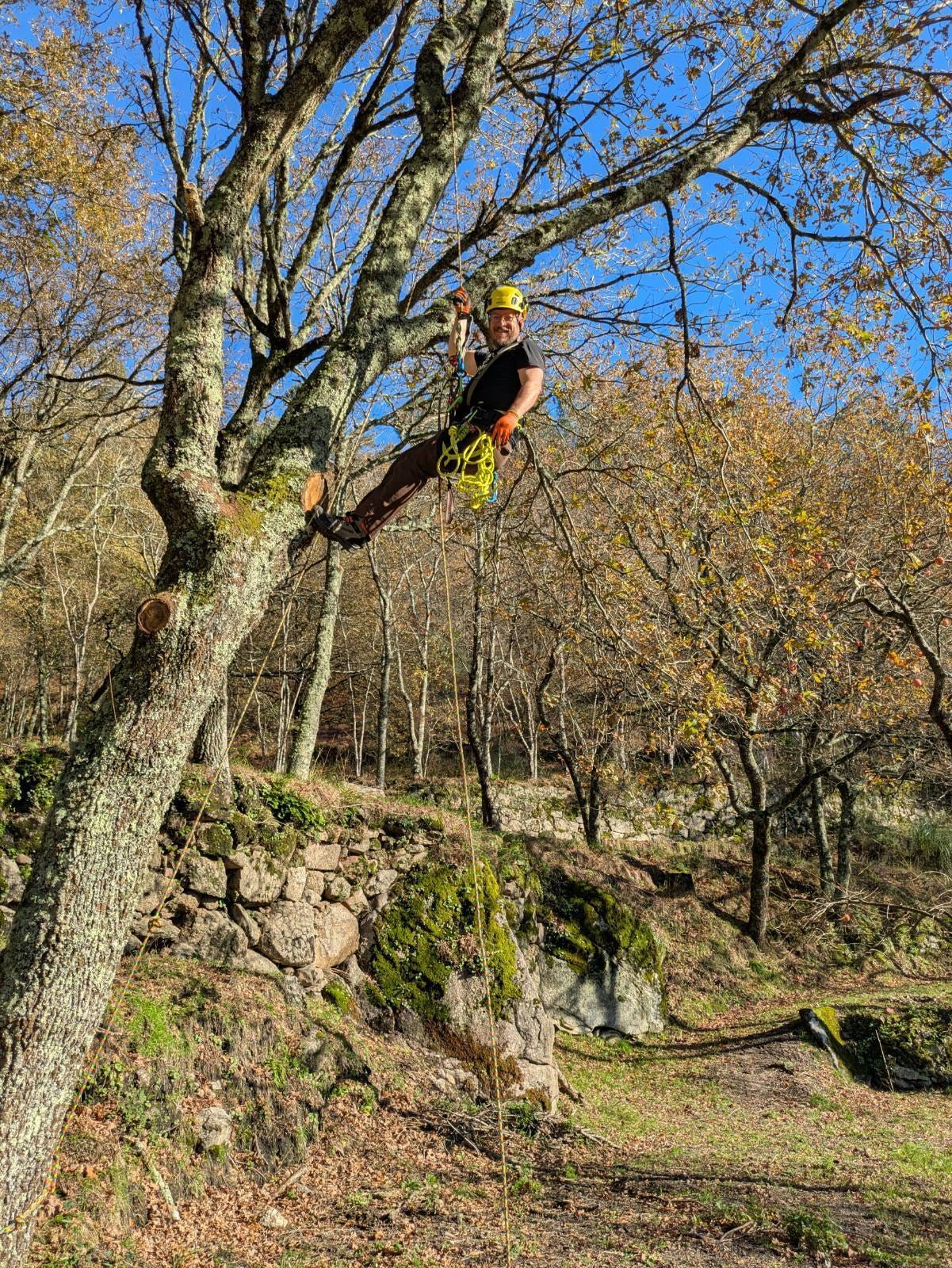
I’m fortunate to own a plot of land in lovely northern Portugal with a small house surrounded by a young forest. We have hundreds of trees, mostly oak, then sweet chestnuts, about ten pines, and five eucalyptuses1. There are various other types sprinkled around, some of which I have yet to identify2. We’ve been told that up to about 40-60 years ago all of the land around us was farmed for sustenance and wine, which was gradually abandoned due to industrialised agriculture; the forest took over and many people planted eucalyptuses in the vacant plots, which is fast growing and has multiple uses (but is bad here in most other respects). Some trees are older; we know this because they’re bigger — well duh! — and they have steel wires embedded within them, painfully strangling, at various heights. These were used for supporting vines, most likely.
The forest as a whole wasn’t maintained for decades. Trees grew wherever they managed to establish themselves, causing dense thin tall trunks competing for sun with thick canopy, letting little light through for other layers that are usually a sign of a healthy forest. Other trees bend and grow in awkward strange ways to reach sunny spots. Some have grown large on edges of terraces, where, if not taken care of, may fall, taking the precious retaining walls with them.
Felling the trees is an obvious solution, but it’s nonsensical in most cases where the tree isn’t posing a danger to people or property. Trees provide protection from storms, fires, and sun. They are magnificent to look at and contribute to the health of the land and whatever lives in or on it. The other option is much more sympathetic to the trees, but is also more expensive, dangerous, time-consuming, and technical.
This is the option that appealed to me for several years. I’ve been thinking of getting into climbing arborist work: climbing trees, making strategic cuts to the benefit of tree and human. I’ve been ogling arborist equipment sites since then, taken aback by the price-tag of getting started (about €1250 including VAT for the basic+ kit). I’ve also watched hundreds of videos and read about arborist work, understanding what I may be getting myself into. It’s the kind of work that requires technical and physical abilities, but also knowledge of trees and physics. No scenario is ever the same! I love that.
The benefits of this work are extraordinary. The tree is better off, the limbs are used for firewood, structures, or landscaping materials, and the branches go to the chipper. Woodchip — been making my own for over a year now — is a minor miracle; it’s great as a weed suppressor and for nourishing the soil: a rare win-win.
A few months ago I pressed the button and ordered the equipment, and have since started practicing for real. It’s been slow progress since I have to wait for a sunny day, and check myself at every step, learning, re-learning, and repeating things several times so that it eventually becomes natural. The picture at the top is from my latest climb. I’ve yet to take the chainsaw up with me, which will happen when I’m more comfortable with the rest of it.
I will write more about my progress in time.
⁂
I should point out that I’m well aware that this work is inherently dangerous, at least more so than a walk in the park. I’m completely confident in both my ability to quickly identify dumb things and situations (and people? hehe), and my self-edification process. An expression I hear sometimes by climbers is ‘trust your gear’, which is interesting to absorb once high on a rope: there’s no choice but to do that! It’s exhilarating.
I know the exact location and number of pines and eucalyptuses because they are undesirable trees in this environment. Pines are shallow rooted that tend to fall when they’re big enough, and they contribute negatively to the progression of wild-fires. Eucalyptuses are allelopathic, consume a lot of water, and also bad for wild-fires. We had a wild-fire last year; a real concern!

There are also fruit trees that were planted before we got here and many that we’ve planted. I don’t count them as part of the forest, of course.
Looks very pretty!